



Cricket is a sport rich in tradition, evolution, and fascinating historical shifts. One of the most interesting questions that continues to intrigue cricket fans, historians, and quiz enthusiasts is: how many balls were originally there in one Test over?
Today, every cricket fan knows that an over consists of six legal deliveries. However, this was not always the case. In the early days of Test cricket, the number of balls per over varied significantly depending on the country and era. The journey from four-ball overs to the universally accepted six-ball over is a remarkable chapter in cricket’s evolution.
In this detailed article, we will explore the complete history of how many balls were originally there in one Test over, trace the timeline of changes, understand why different formats were used, and examine how the modern six-ball over became the global standard.
Before diving into history, it is important to understand what an over means in cricket.
An over is a set of consecutive legal deliveries bowled by one bowler from one end of the pitch. After completing an over, another bowler bowls from the opposite end. Overs help structure the game, regulate bowling workloads, and provide rhythm to the contest between bat and ball.
In modern cricket:
However, historically, this structure was very different.
The original number of balls in a Test over was four balls.
When Test cricket began in 1877 (Australia vs England at Melbourne), overs consisted of four deliveries. This format was adopted from the laws of cricket in England at the time.
But the story does not end there. The number of balls per over changed multiple times across countries and decades before finally being standardized.
Test cricket officially began in March 1877 when Australia hosted England at the Melbourne Cricket Ground. During this period:
The four-ball over was rooted in English cricket traditions of the 19th century. Cricket laws were not as rigidly standardized internationally as they are today, and local cricket boards had flexibility.
There were several reasons:
As cricket expanded beyond England and Australia, different nations experimented with over lengths.
Some used:
This lack of uniformity created interesting variations in match structure and strategy.
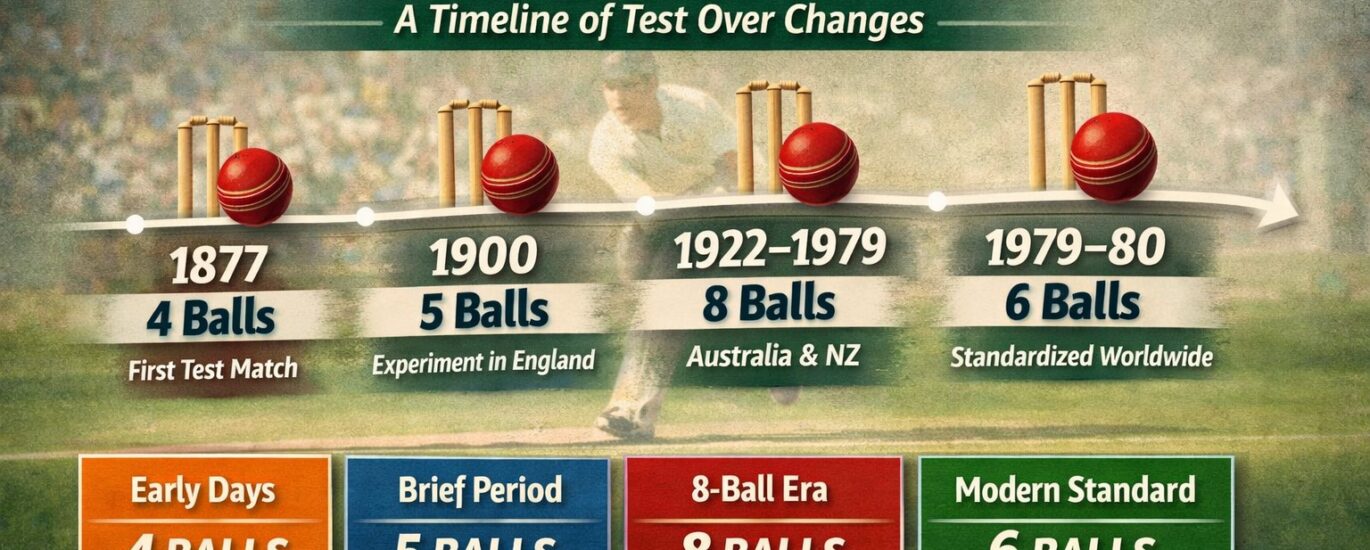
Below is a clear timeline table showing how many balls were originally there in one Test over and how it evolved:
| Year / Period | Country | Balls per Over | Notes |
|---|---|---|---|
| 1877 | Australia | 4 balls | First-ever Test match |
| 1880s | England | 4 balls | Standard at the time |
| 1889–1900 | Australia | 4 balls | Continued early format |
| 1900 | England | 5 balls | Short experimentation period |
| 1902 | England | 6 balls | Introduced six-ball over |
| 1922–1939 | Australia | 8 balls | Shifted to eight-ball overs |
| 1937–1979 | Australia | 8 balls | Continued for decades |
| 1968 | New Zealand | 8 balls | Adopted eight-ball format |
| 1979–80 | Worldwide | 6 balls | ICC standardized globally |
This timeline shows that while the original Test over had four balls, the structure evolved significantly before settling at six.
In 1900, England briefly experimented with five-ball overs. This period was short-lived and did not gain long-term acceptance.
Reasons for experimenting:
However, the five-ball over did not prove practical in the long term.
England officially adopted the six-ball over in 1902. This format began gaining popularity because:
Gradually, other cricketing nations began transitioning toward six-ball overs.
One of the most fascinating chapters in cricket history was the eight-ball over.
Australia famously used eight-ball overs from 1922 until 1979. This means legendary players such as Don Bradman played during the eight-ball era.
However, it also affected:
Changing the number of balls per over affected cricket statistics significantly.
For example:
A bowler taking five wickets in an eight-ball over era bowled more deliveries per over than modern bowlers.
This is why cricket historians always consider context when analyzing records.
By the late 1970s, international cricket needed consistency.
Reasons for standardization:
In 1979–80, the ICC officially made six-ball overs mandatory worldwide.
The number of balls in an over influences:
In the four-ball era, bowlers had less time to build pressure in a single over. In contrast, eight-ball overs allowed sustained attacks.
Modern six-ball overs strike a balance between aggression and endurance.
To summarize clearly:
So, historically speaking, four balls were originally there in one Test over.
When cricket began as a formalized international sport in 1877, the game was deeply rooted in English traditions. Overs were modest, consisting of four balls, reflecting the slower pace and endurance-based nature of the era. As cricket expanded to Australia, South Africa, and New Zealand, each nation shaped the game slightly differently.
The early 20th century was a period of experimentation. England’s five-ball phase, Australia’s eight-ball revolution, and eventual international debates highlight cricket’s adaptive nature. By the late 1970s, globalization of cricket and commercial growth required uniformity, leading to the adoption of six-ball overs across all formats.
Today, the six-ball over is so ingrained in cricket culture that many fans are surprised to learn that Test cricket originally began with just four balls per over.
Originally, a Test over consisted of four balls when Test cricket began in 1877.
England adopted six-ball overs in 1902, but global standardization happened in 1979–80.
Australia and New Zealand used eight-ball overs for several decades in the 20th century.
They were removed to ensure international consistency and fairness in statistics.
Yes, many of Bradman’s matches in Australia were played under the eight-ball over system.
The five-ball system was short-lived because it did not provide a balanced rhythm compared to six-ball overs.
No. All international formats today use six-ball overs.
Different over lengths changed workload calculations, economy rates, and strike rates, making cross-era comparisons complex.
The history of how many balls were originally there in one Test over reveals the fascinating evolution of cricket. What began as a four-ball over in 1877 transformed through experimentation with five and eight-ball overs before settling into the globally accepted six-ball structure.
This evolution reflects cricket’s adaptability, strategic depth, and growing international coordination. Understanding this journey not only answers a historical question but also deepens appreciation for the game’s rich heritage.
Cricket today may appear standardized and uniform, but its past tells a story of experimentation, regional identity, and gradual unification — all beginning with a simple four-ball over.


Rerum congue dis illo ridiculus beatae nesciunt assumenda nostra. Viverra ipsum fuga, per ipsam leo sodales litora ullam assumenda ultrices.